How I Saved A Life For $5,000

The title of this post is a little misleading. I sat at my computer one morning, and with a couple of clicks, donated $5,000 to a charity based in Cambridge, England. Statistically, however, that $5,000 will save someone’s life.

Let’s Start From The Beginning…

I was peer pressured into charitable giving my friend Matt Brand. He and his wife have donated over $100,000 to charity, aiming to donate 10% of their income each year. He told me about an anonymous poll he took of his former computer science classmates (a lucrative field) and found that very few were making charitable donations, despite a majority working for big tech companies with high salaries.

I was embarrassed. I too had a good job, living in a low cost city, with no dependents, and was donating almost nothing to charity. What was my excuse? Naturally, I did nothing to ease this guilt until…

Goal #25: Donate $5,000 To Charity

These lists of goals are a great way to do things I know I should do, but don’t want to. I chose an amount that felt significant but would not induce so much financial stress that I’d be permanently turned off from donating again. Baby steps.

But Which Charity To Donate To?

I stumbled upon an episode of the Tim Ferriss podcast where he interviewed Will MacAskill, a pioneer in the field of Effective Altruism. MacAskill approaches donating to charities like investing in a business. Which one has the best return on investment?

The best known charity ranking website is Charity Navigator, which compiles its ratings based largely on what percentage of donations are spent on fundraising/salaries/operations. MacAskill argues this is a poor way to rate charities. A much better way would be to see how effective the charity is with each dollar donated, rather than how efficient the charity is. We should care about the results a charity produces rather than how much they spend on executive pay and fundraising. MacAskill points out that the most effective charities are hundreds or even thousands of times more effective than merely ‘good’ charities.

Why I Chose The Against Malaria Foundation

The Against Malaria Foundation is the highest rated charity by Give Well, an organization that rates charities based on their effectiveness. On average, the Against Malaria Foundation saves a life for $3,500 by providing long lasting insecticide treated bed nets across the world. Deaths from malaria numbered over 400,000 last year, largely children under the age of 5. The analogy used is two 747 airplanes fully loaded with children crashing everyday. Tragic, right?

Against Malaria Foundation

The Most Tax Efficient Method To Donate

This $5,000 donation runs counter to my net worth goals. It’s well known that donating to charity is tax deductible. That will save us approximately $1,500 this year in taxes, reducing the actual cost of my donation to $3,500. But wait there’s more…

I donated $5,000 worth of appreciated stocks from my taxable investments through my investment company Betterment. When you donate stocks that have increased in value, you don’t pay capital gains tax, and the charity doesn’t pay capital gains tax either. Seems like a loophole, but it saved us an additional $200. Betterment makes this process extremely simple and has a great explanation of the whole process.
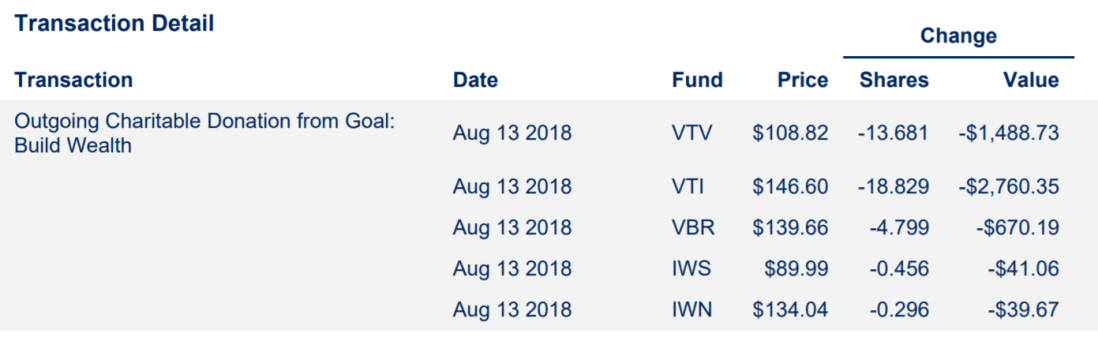
Donated Shares

I Clicked Submit, and Felt…Nothing

Logically, I know this is a significant impact, but it didn’t seem like it. I felt a sense of accomplishment since I finished one my goals, but little else.

I asked my buddy Matt Brand about this, and he said he feels the same way, but that he believes it’s his responsibility to donate. That’s a good way of looking at it.

I live in a country with tremendous prosperity, and with a couple of clicks on my computer, can significantly impact the life of someone halfway around the world. No heroics needed. What an extraordinary opportunity, right?

The 2018 Washington Island Ultra: 24 Hours Of Triathlon

Goal #5 on my 30 Before 30 list was to complete an ultra endurance event. ‘Ultra endurance’ was loosely defined in my head as something taking longer than 8 hours. I added this goal since it had been over two years since I completed an event of that magnitude.

I stumbled upon the Washington Island Ultra, a ‘choose your own adventure’ of any combination of (8, 12, 24, 36 hour)  and (solo or team) and (triathlon, duathlon, or cycling). I thought it was an interesting event, as well as cheap and nearby, so I registered for the 24 Hour Solo Triathlon.

Course

0.25 Miles swim loop in Lake Michigan, 10 mile bike loop around Washington Island. and 2 mile run loop out and back from the campsite. Complete as many loops as you could, in whatever order you want.

Race reports are boring to write and exhausting to read, even if you’re into this kind of stuff. So instead, I”ll give you a brief overview of the thoughts going through my head throughout the event.

Swim #1 – 2.5 Miles

It’s a 24 hour race so I should take it really easy to start. But I should catch that guy ahead of me first! I am going to destroy this race. I’m the juggernaut!

Run #1 – 10 Miles

If I run more miles in a day than I have in any week in the last year, does that guarantee an injury? Is it socially awkward to cheer on other runners if you just saw them 5 minutes ago, and will see them again in 10 minutes (it was a two mile looped course)? How many permutations of good/great/excellent and job/work/form are there?

Bike #1 – 50 Miles

First 30 miles: When Alexis is making boo koo bucks, we should definitely get a house out here. These rolling hills are far better than my basement trainer. 12 hours on the bike is going to be no problem.

Last 20 miles: If I’m four hours into the race and ready for it to be over, how am I going to feel 20 hours in?

Run #2 – 12 Miles

What happened to the speed of the first run? Is it still considered running if I walk/hobble along for 12 miles? Why doesn’t anyone cheer you on when you’re walking? Why is there a guy in a bear suit doing the floss on the side of the road? It’s too early to be hallucinating…

Bike #2 – 50 Miles

Fuck running! I’m superman on this bike, but why is everyone passing me? They must be on relay teams…

Run #3 – 12 Miles

[SUNSET]

Just jog to that tree, then you can walk again. Your reward for finishing the next loop will be using the restroom.

Mmmm….Skittles! Changing the green Skittle from lime to apple was one of the greatest achievements of the last decade. If only they could fix yellow and orange.

Bike #3 – 70 Miles

Deer…Deer…Deer. Where were all you guys hiding during the daylight? I’m going to invent a sport where you ride a bike and shoot at deer. We’ll call it biathlon. I’m moving slow, but a 15 MPH collision with a 150 pound deer might kill me.

[SUNRISE]

These Pop-Tarts are delicious. Why didn’t I buy more Pop-Tarts!

Swim #2 – 1.75 Miles

I’m just going to pee here in my wetsuit. Why did I think an hour of swimming would be a ‘victory lap’? Just don’t drown, that would be embarrassing. Nobody can see you cry when you’re swimming.

Wrap It Up!

Overall, I swam 4.25 miles, biked 170 miles, ran (maybe traveled by foot would be a better description) 34 miles, and slept 0 hours. I got smoked by the first place guy. He did 240 miles!

I was pleased with how this race went. I wasn’t in great shape, but finished without any injuries, and suffered for the good part of 16 hours. The post race beer from the guys in the tent next to me hit the spot.

Next Year

Running, biking, and swimming for 24 hours sucks, but the race itself was fantastic. It had a super relaxed, ultra-marathon type vibe, with a majority of competitors camping on site. I plan on doing it again next year, aiming for a longer distance. A double Ironman (4.8 mile swim, 224 mile bike, 52.4 mile run) would be possible if I was in good shape and an Ultraman (6.2 mile swim, 261.4 mile bike, 52.4 mile run) would be feasible if I was in elite level shape.